Equal Playing Time: The Argument Nobody Wants to Have
Written by The Sporting Resource
I have stood on enough touchlines over 15 years to know exactly what the conversation sounds like.
It happens in car parks after games, in WhatsApp groups on Sunday evenings, in the quiet exchange between two coaches who both know the score but neither wants to say it out loud.
It carries the weight of principle, it talks about commitment, about fairness to the children who prioritise training, who show up regardless of the weather, who give everything and expect the environment to recognise that. It sounds completely reasonable until you ask the one question that nobody in that car park wants to sit with. Whose experience are we actually talking about protecting?

Somewhere in that car park conversation, in that Sunday evening WhatsApp thread, there is a child who sat on a bench for far too long last weekend and came home quieter than they left. Not upset in a way that anyone would notice, not making a scene. Just a little quieter, a little further from the door of something they had only just started to find out whether they loved.
That child is who this Article is about.
How adult expectations crept in
It crept in without announcement, without anyone standing in a room making the case for adult priorities over children's experience. It arrived the way these things always do gradually, without an announcement, wearing the language of development and standards and preparing young people for the real world.
The competitive instinct that is entirely appropriate at the professional level followed us onto the Saturadya morning touchline. The desire to win, the identity wrapped up in results, the scoreline as a measure of the coach's worth and the parent's pride, all of it crossed the white lines that are supposed to mark the boundary between the adult world and the one we created for children.
Many coaches never noticed it occurring, that is the honest truth. The pull toward selecting the strongest players, toward rewarding those who are clearly committed and clearly talented, toward building a team that can compete rather than a squad where everyone belongs, it feels like good values. It feels like integrity and like the kind of principles that will serve young people well further down the road.
The difficulty is that further down the road is not Sunday morning. That particular morning represents the foundational stage of a child's relationship with sport, and the choices made there who plays, who watches, who is told through half an hour on a bench exactly how much their presence matters are not neutral technical decisions. They are statements about whose experience the environment was designed to honour.
The argument against equal playing time made honestly
The coaches who push back on equal playing time are not bad people and their arguments are not stupid. They deserve genuine engagement rather than dismissal, because some of them are genuinely trying to do right by the children they coach.
Playing time should reflect commitment, if a child is late every week, misses training regularly, and shows up on match day expecting equal time, what message does automatic inclusion send to the children who prioritise it, who show up early, who give everything in training? Standards matter, and standards without consequence are not standards at all.
Stronger players need to be challenged, a child with genuine ability who spends half the game on the bench because the squad is large isn't developing, they're waiting. Their potential is being managed downward in the name of inclusion.
Competition prepares children for life, the real world doesn't guarantee everyone equal opportunity. Teaching children that showing up is enough, regardless of quality or commitment, is arguably doing them a disservice. Some argue that protecting children from the reality of merit-based selection simply delays a reckoning that will arrive eventually.
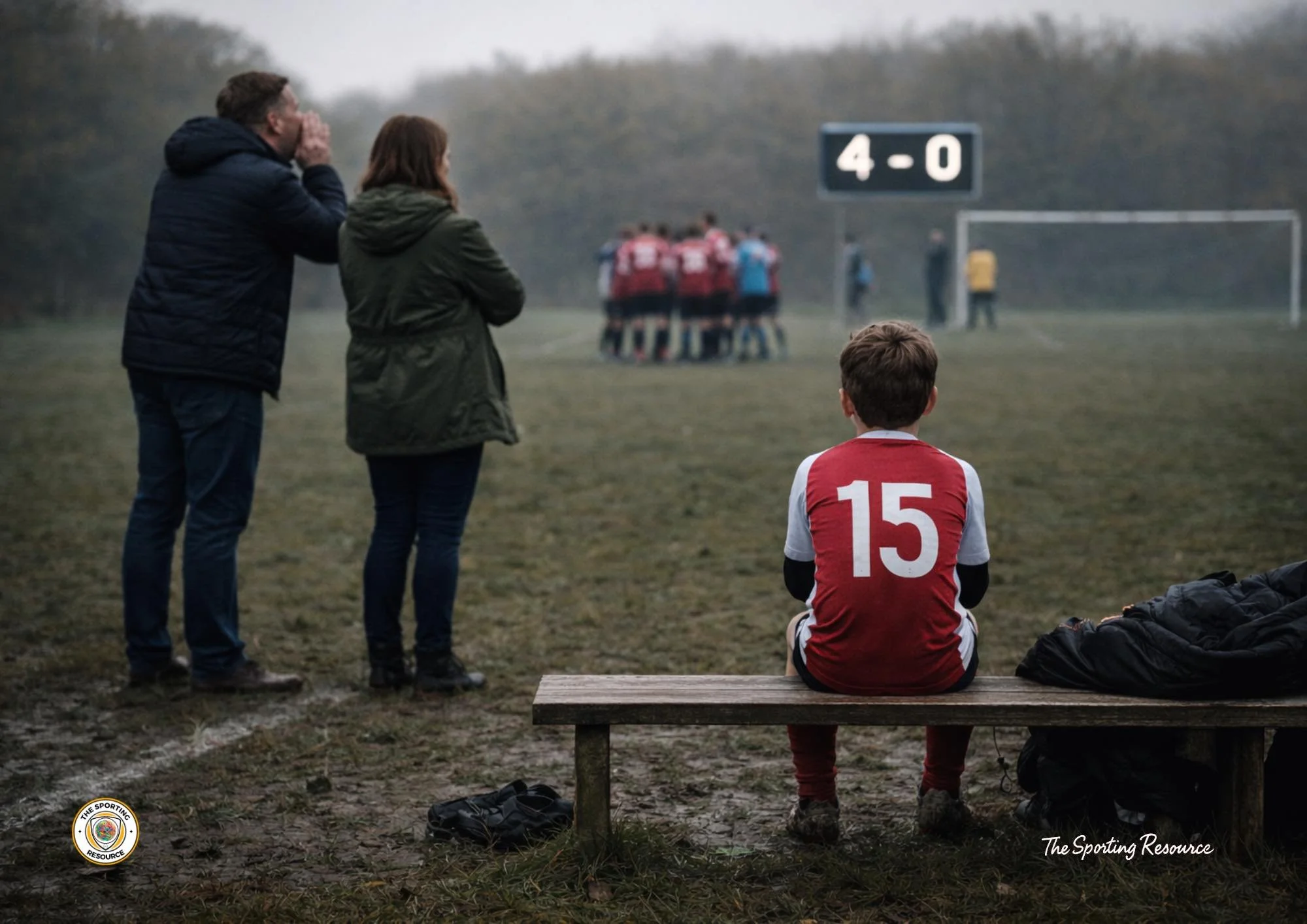
These arguments have weight, they deserve to be heard before they are answered. The question isn't whether standards matter, of course they do. The question is what standards are appropriate for a seven-year-old who is still finding out whether they like football, and who is setting those standards, and whose interests they actually serve.
Before the counter-argument arrives because it always does, let me say something clearly. Achieving equal playing time to the exact minute, or the precise second, is not always realistic and anyone who has stood on a touchline in the real world already knows that. Players don't show up because of illness, because of family commitments, because another sport has a fixture that clashes. Players pick up knocks during the game and have to come off. Players occasionally need to leave early for reasons that have nothing to do with football. The squad that looked manageable on Friday evening looks completely different by Saturday morning. I have been there, every grassroots coach has been there.
The point was never mathematical precision. The point is the intention behind the decisions whether the coach managing that complicated Saturday morning is genuinely trying to give every child who is still standing on that touchline as close to equal opportunity as the situation allows, and whether that commitment carries across the whole season rather than sitting in the small print of a single fixture. A child who misses a game through illness and gets proportionally more time across the following weeks has been treated equitably. A child who consistently receives the least time because the coach has quietly decided they matter least has been told something that no amount of good intention can take back.
The complexity is real, but the commitment to fairness within that complexity is a choice.
There is one more thing worth saying here, and it is directed at the parent or coach reading this on behalf of the child who arrived already loving football, who has been determined from the moment they first kicked a ball, who trains with genuine intent and competes with everything they have.
Equal playing time does not diminish that child, it serves them too.
The determined child develops better in an environment built on genuine participation than in one built on manufactured scarcity. When every child in the squad feels they belong, when no child is quietly processing what the bench is telling them, when the culture of the team is inclusive rather than hierarchical the determined child trains alongside players who are invested, who are present, who want to be there. That environment produces better footballers and better people than one where the bench has already done the selecting.
The child who loves this game doesn't need exclusivity to thrive. They need a coach who is honest, an environment that is healthy, and the opportunity to develop their ability within a squad that genuinely functions as one. Equal playing time gives them exactly that.
Whose needs are being served

Here is the uncomfortable question underneath the comfortable argument.
When a coach selects the strongest eleven and leaves four children rotating through twenty minutes each on a cold Saturday morning, is that decision primarily about developing the children or is it primarily about the result?
When a parent arrives at a grassroots game and spends the session calculating how many minutes their child played compared to others, whose experience is at the centre of that morning?
When the WhatsApp group fills up on Sunday evening with debate about selection and playing time and commitment levels, who is actually driving that conversation and who is sitting at home, quietly wondering whether they will bother coming back next week?
The scoreline at foundational level has become a proxy for adult validation. The coach whose team wins twelve in a row at under nine level isn't developing better footballers they're feeding something in themselves that has very little to do with the children in front of them. The parent who needs their child to be starting every game isn't watching their child's development they're watching a version of their own identity play out on a small pitch on a Saturday morning.
Children at foundational level are not there to service adult emotional needs. They are there to find out whether they love the game and every decision that places adult priority above that discovery is a decision that costs the game something it will never count and never recover.
The child who quietly disappears
There are two kinds of children who get left behind by unequal playing time.
The first kind makes their feelings known , they complain on the way home. They tell their parents they don't want to go anymore. Their withdrawal is visible and audible and gives adults something to respond to.
The second kind is quieter and costs the game far more, they say nothing. They come back the next week because they haven't yet made the decision not to. They sit on the bench and they watch and they process what the bench is telling them, which is that they are not quite enough, not quite important enough, not quite the kind of player this environment was really built for. And one week they just stop coming.
No drama, no conversation that anyone could learn from. They simply drift away from something they might have loved, having received the message clearly enough without anyone needing to say it out loud.
That child, the quiet one, is the one the game loses and never counts. They don't appear in any data set. Nobody tracks the eleven-year-old who played four minutes in their last three games and quietly decided football wasn't for them. Nobody follows up and nobody asks what happened.
What if that child, given the time and the opportunity and the simple dignity of being included, had fallen in love with the game at thirteen instead of nine? What if the thing that was going to make them a player a late physical development, a growing confidence, a moment of genuine joy in a game where they actually played was six months away when the bench made the decision for them?
We will never know. That is the cost of unequal playing time at foundational level, and it is paid entirely by the child.
What the (NGB) FAW already says

Here is what makes this conversation more than philosophical.
The Football Association of Wales has already answered the equal playing time question. It answered it in regulation, not in guidance, not in best practice advice, but in mandatory rules that apply to every affiliated club in Wales.
Rule 5.1.4 of the FAW Small-Sided Football Regulations states that all players in the match day squad must participate in a minimum of 50% of total playing time available. At an U10 festival where the total playing duration is 60 minutes, every player in the squad must play at least 30 minutes. At U8 with 50 minutes available, every player must play at least 25 minutes. This is not optional. It is not a recommendation. It is a mandatory requirement.
Rule 4.4 goes further. At U6, U7, U8 and U9 age groups, no substitute must wait longer than five minutes before being involved in the match. At U10 and U11, no substitute waits longer than ten minutes. Again, mandatory, not advisory.
Rule 3.4 states that clubs with multiple teams at a specific age group must mix player abilities across all teams. There should be no A and B teams made up of perceived strong and weaker players. The regulation is explicit about the purpose to ensure a positive playing experience for all participants where the focus is on fun and skill development.
The FAW has already decided this question. The governing body looked at the evidence, looked at what children need at foundational level, and put these protections into its regulations because it understood something important equal playing time at this stage of development is not a soft compromise of standards. It is a standard in itself.
The honest question the coaching community needs to sit with is this. How consistently are these regulations being applied? How many coaches running U9 teams in Wales this weekend know that waiting longer than five minutes on the bench is a regulatory breach, not just a coaching preference? How many league administrators are actively monitoring compliance? And what does it say about our coaching culture that a governing body felt the need to legislate for inclusion in the first place?
The equal playing time regulation is not the only place the FAW has tried to protect the experience of children at foundational level. Two further initiatives are worth understanding clearly, because they are frequently misread.
The mercy rule, introduced for U12 to U17 age groups, states that when a team leads by eight goals the competitive element of the match is declared over. The score is recorded, the match continues, but the remainder is played as a friendly with all the laws of the game still applied by the match official. The home team ends the match time on the league system at that point and the score is locked in.
This rule is not telling coaches to avoid winning, it's not removing competition from youth football or protecting children from the reality that some teams are better than others. It is recognising something that anyone who has stood on a touchline and watched an 18-0 game unfold already knows that a scoreline at that margin stops being a development environment for either team. The winning team stops being challenged. The losing team stops competing in any meaningful sense. The match official spends eighty minutes managing a situation that serves nobody's development. The eight-goal threshold is the point at which a governing body decided the educational and developmental value of continuing competitively had been exhausted, and it is difficult to argue seriously with that position.
The power play rule, available as an optional measure for U6 to U11 age groups, operates on a similar principle. If one team is losing by four goals they can add an extra player a 5v5 becomes a 5v6. If they score and reduce the gap to three, numbers return to equal. If the lead grows to six goals, the losing team can add two players. Rotations are shared fairly across the squad so the same player is not always the one coming on or off.
Both rules operate on the same principle that underpins the equal playing time regulation. The game still happens. Competition still exists. The result still matters. The experience is protected for every child on the pitch, not just the ones who are already winning.
That is not softness, that is good coaching design and it comes from a governing body that has looked at the evidence on what keeps children in football and what drives them away, and has tried to build a framework that protects the game's foundation while keeping the game intact.
The mercy rule, the power play, and what they actually mean
What facilitation actually means
We chose this role, either because we wanted to coach or nobody else wanted to, we still chose to coach. That is the thing worth remembering when the conversation in the car park gets heated, when the WhatsApp group fills up on Sunday evening, when the temptation to prioritise the result over the experience becomes harder to resist.
We are not professional managers with contracts depending on results. We are not scouts identifying the next generation of elite talent. We are the first experience many children have of a structured sporting environment, and that first experience shapes everything that follows, their relationship with competition, with belonging, with their own ability, with the game itself.
The grassroots club is the underpinning layer of the entire sport. Everything that happens at next levels, the academies, the professional game, the national teams rests on a foundation of children who kept playing because their first experience of football was joyful and inclusive and safe enough to come back to. When we get the foundational level right, we don't just develop better footballers, we sustain a game.
When we get it wrong, when we select exclusively, when we manage playing time around the scoreline rather than the child, when we allow adult priorities to crowd out the experience of a seven-year-old who is still deciding whether this is something they love, we don't just lose that child. We lose every child they might have brought with them, every parent who might have volunteered, every future coach who might have emerged from a positive experience of the game rather than a quiet exit from it.
The child who stays in football because their first environment made them feel like they belonged becomes the player, the parent, the volunteer coach, the Saturday morning referee, the person who sustains the game for the next generation. The child we lose at nine because they spent too many Sundays on a bench is a cost the game pays quietly and never counts.
One question for this weekend
Before you confirm your squad rotation for Saturday morning, ask yourself one thing.
If the child who plays the least minutes this weekend decides not to come back next week, will you notice? Will you know why? Will anyone follow up?
If the honest answer is no, that the child who sits on the bench longest is also the child most likely to drift away without anyone registering it then the question of equal playing time has already answered itself.
You are not just managing a squad, you are managing someone's first relationship with a sport that could be part of their life for the next seventy years, or could end on a cold Saturday morning when the bench told them something that nobody ever said out loud.
The FAW has already told you what the minimum standard is. The question is whether you're willing to go further than the minimum not because a regulation requires it, but because the child in front of you deserves it.
The Sporting Resource exists to support grassroots coaches across every level of the game. You can find free resources, tools, and coaching support at https://www.thesportingresource.co.uk/